Whitelisting (Allowlisting)
Updated July 2026
Whitelisting, also called allowlisting, is when a creator grants a brand permission to run paid ads through the creator's own social account, so the ads appear to come from the creator's handle for greater authenticity and reach.
In influencer whitelisting, the creator authorizes a brand's ad account to use their handle and content for paid promotion — for example via Meta's partnership (branded content) ads. The ad runs under the creator's identity but is targeted, optimized, and scaled by the brand's media team.
This lets brands extend a high-performing organic post into paid reach while keeping the creator's authentic voice. The term 'allowlisting' is increasingly preferred over 'whitelisting' for inclusive-language reasons; both describe the same permission.
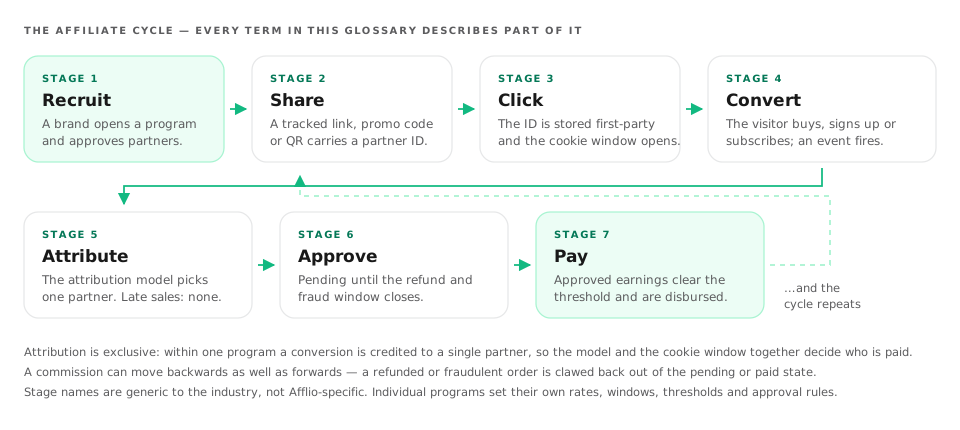
Where Whitelisting (Allowlisting) sits in the affiliate cycle
Whitelisting extends the share stage past the creator's own audience: the brand runs paid ads from the creator's handle.
How Whitelisting (Allowlisting) actually works
Whitelisting, also called allowlisting, is the creator granting a brand advertising permission on their account so the brand can run paid ads that appear to come from the creator's handle rather than from the brand. The brand controls targeting, budget and the ad set; the creative and the identity are the creator's.
It is distinct from simply boosting a post. The brand is running its own campaigns, to audiences the creator never reaches, with the creator's name attached — which is why the permission is granted with a scope and an expiry rather than open-ended.
What Whitelisting (Allowlisting) means for a creator
Whitelisting is a separate, chargeable right rather than an extension of a normal post fee. The brand is buying your identity as ad creative and using it against audiences you have no relationship with.
Bound it carefully: a fixed term, a defined set of campaigns or products, and the right to review the ad copy. Without those, your handle can end up attached to claims you would not have made, in front of people who will attribute them to you.
What Whitelisting (Allowlisting) means for a brand
Creator-identity ads typically outperform brand-identity ads in feed environments, because they read as content rather than as advertising, and the creative is already proven with a real audience.
The obligation that comes with it is disclosure and accuracy. An ad running under a creator's handle is still an ad, and the claims in it are the brand's responsibility even though the face is not.
Common mistakes with Whitelisting (Allowlisting)
Granting open-ended advertising permission
Permission without an expiry or a scope can keep running long after the relationship has ended. Tie it to a term and a named set of campaigns.
Treating it as included in the post fee
It is a distinct right with distinct value — the brand is buying the creator's identity as ad creative, not a placement to the creator's own audience.
Running ad copy the creator has not seen
The audience attributes the claim to the person whose handle it appears under. Review rights protect both parties.
Whitelisting (Allowlisting): common questions
What is the difference between whitelisting and boosting a post?
Boosting amplifies an existing post to a wider audience. Whitelisting lets the brand run entirely new ad campaigns from the creator's handle, with its own targeting and budget, to audiences the creator does not reach.
Should creators charge extra for whitelisting?
Yes. It is a separate right — the brand is licensing your identity as advertising creative — and it should be priced by term and scope rather than bundled into a post fee.
Do whitelisted ads need disclosure?
They are advertising and are labelled as such by the ad platform. That labelling does not remove the brand's responsibility for the accuracy of the claims made under the creator's name.
See also
- Influencer Marketing
Influencer marketing is a strategy in which brands partner with creators who have engaged social audiences to promote products, paying through flat fees, free product, affiliate commissions, or a combination.
- Sponsored Post
A sponsored post is social or blog content a creator is paid to publish promoting a brand, which must be clearly disclosed as an ad under FTC and comparable rules.
- UGC (User-Generated Content)
User-generated content (UGC) is content — photos, videos, reviews, and posts — created by customers or creators rather than the brand itself, valued in marketing because it feels authentic and trustworthy.
- Brand Deal
A brand deal is a paid agreement between a brand and a creator to promote the brand's product, defined by deliverables, usage rights, exclusivity, timing, and a fee or commission.
- Reach vs Impressions
Reach is the number of unique people who saw a piece of content, while impressions count the total times it was displayed including repeat views — so impressions are always equal to or greater than reach.
Turn the theory into a live program
Afflio handles tracking, commissions, and payouts so you can run the program these terms describe — start free in an afternoon.